June 16, 2019

Kaafir - Movie Review

Image Credit: https://zeetv.zee5.com/kaafir-character-promos-meet-kainaaz-akhtar-seher-and-vedant-rathod/

Few movies are so powerful that it makes you cry with the protagonists, feel what the actors are feeling. Few movies are so well directed that it focuses at several subtle and sensitive aspects of the society in a very powerful way. Kaafir does all that, and more.
(Kaafir is a Web Series being telecast on Zee5.com. Terming it as "movie" for sake of convenience)

There is a scene in the movie where the protagonist Kainaaz- a Pakistani woman- is sent to jail and inside the jail lockup, first, Hindu women tell her to move away sit on the Muslim women's side, and when she goes to the Muslims' side, Muslim women tell her to shift away sit in the Pakistani section of the jail lockup. The helpless, emotionless expression on Kainaaz's face, breaks your heart. 
In another scene, after a terrorist blast in J&K, some angry youngsters attacked the army officer's house where Kainaaz was staying (since she was a Pakistani). With kainaaz inside with her daughter, they set the house on fire. The two persons who came to rescue both had their relatives' killed in terrorist attacks earlier. One was Suri Uncle's wife who had lost her husband in the very terrorist blast, and another was Vedant, who had lost his army officer brother in a terrorist attacks several years earlier. The incident shows the great divide in society, the divide of blind hatred and matured conscience.
The movie is not only of a Pakistani woman stuck in Indian jails on flimsy grounds of "National security" (flimsy because there was no evidence, and no investigation) . It is also the story of the struggle in the life of a woman, who has to play the role of a daughter, a wife, and a mother in extreme circumstances of the patriarchal, misogynist world. What's more, the movie is also about a righteous man's resolve and conviction in doing the good. The movie is about the fight of good vs the bad elements of society, where ultimately the good wins, but after a lot of pain and sacrifices. 
A still from the movie, where Kainaaz, after winning her freedom from court,
falls on her feet crying, and her little daughter comes running to console her
Look at it- the woman protagonist Kainaaz played by Dia Mirza- first gets ditched by her husband in Pakistan, then she jumps into river to commit suicide, doesn't die but lands into Indian jails. There she gets served 15 months jail term, gets raped by a jailer, and has to remain under extreme circumstances in the jail, not for just 15 months, but for more than 8 yrs!
And look at the male protagonist in the movie- Vedant, played by Mohit Raina, he is from a military family- his two brothers are in army and his father is a retired Police officers. The irony in his life, is that his younger brother was killed by a terrorist, who he himself had got released from jail in capacity of lawyer, under impression that the guy was innocent and not a terrorist! And yet again, he takes up the case of a Pakistani woman Kainaaz! He also takes it up going against his father's constant opposition.

The movie touches upon several delicate issues, and focuses on many conflicting emotions in the minds of the lead protagonists. There is an angle of love and sacrifice, there is the element of guilt, and there is the depiction of great resolve and conviction in face of severe extreme circumstances. Dia Mirza does magic with her acting and expressions, she absolutely dives into the character making it to so real that you feel her pain as she faces. Mohit Raina in his role of the lead male protagonist too plays a great part. The Child actor Dikshita Jain is so cute, lovely and innocent. Several of her innocent questions bring smile on your face. The script writer of the movie has been superb. The movie is replete with several deep dialogues which touch your heart. All in all, this is one gem of a movie, one is a million kind, not to be missed at all. The director, producers and the entire team deserves a huge applaud for making a movie on such theme, with such nuance and depth.

Ending it, I would like to mention a few of the many, fabulous dialogues from the movie:-

"हम जेल वापस चलते हैं अम्मी, यहाँ बाहर मुझे अच्छा नहीं लगता है"

"कायनाज जी, हाथ खुले हो या जुड़े हो, कोई फ़र्क़ नहीं पड़ता; इबादत का तरीक़ा नहीं, नीयत मायने रखती है"

"जेल की खिड़की की सलाखों से जब मैं खुले आसमान और पहाड़ों को देखती, तो मुझे वही खुला आसमान और पहाड़ नज़र आते, जो मेरे मुल्क में भी है क़ुदरत सब के लिए एक है, इंसान ही लकीरें बनाता है"

"दुनिया को अगर नफ़रत की निगाहों से देखा जाए तो हमें नफ़रत का ही एहसास होता है। अगर हम दुनिया को प्यार की निगाहों से देखें तो, प्यार का एहसास होता है"

"मारने वालों से बचाने वाले बहुत ज़्यादा हैं, लेकिन बस बेटा वो चुप रहना सीख गए हैं"

"लोग लड़ते हैं मिलने की ख़ातिर,
पर अपनी तो बिछड़ जाने की लड़ाई थी |
जीत मिली हम दोनो को बस, बस आँसू की कमाई थी " 
(the small part of the longer "The Kaafir Poem" by Swanand Kirkire )

August 15, 2018

Understanding Partition of India: Some of the Best Books to read


So a few years back, I really got fascinated about the partition saga. I got really curious to know more about the factors leading upto partition. I had always read conflicting theories about partition through online articles and social media debates. Some used to blame Britishers for deliberately partitioning India for their own benefits, some blamed Jawahar Lal Nehru for partition, and some even used to blame Gandhi ji for the partition!! All these talks and online readings made in bits and pieces, gradually made me curious about the partition issue, and I thought to read some books on the matter. So below are some of the books I have read, and some quick review about those books:-

 
1) Pakistan or the Partition of India :
Written by Dr. B.R. Amdekar, I read this book first, fascinated by it's title probably. This book has looked at the partition issue from a sociological perspective. Dr. Ambedkar seems to have had an immense knowledge and awareness of historical and political struggles going on around the world, and he has put forth his arguments on that basis. Dr. Ambedkar has discussed in detail about both pro-Gandhi and anti-Gandhi factions, and interestingly he has criticized both. On one hand he has discussed V.D. Savarkar's orthodox, Hinduism related policies, and on another, he has discussed Mahatma Gandhi's policies of  trying to bridge Hindu-Muslim gap by taking steps favourable to them. He has been a fierce critic of Gandhi ji. He has pointed out that despite Mahatma Gandhi's desperate efforts towards communal harmony, there was no let down in Hindu-Muslim riots. He has discussed the concept of  "Country" and "Nation", and he has thrown light on the concept of the famous "Two Nation theory", i.e. there lived two nations in the country named India. A major part of his book is focussed on discussing the huge sociological divide between Hindus and Muslims in India. He has tried to make his point that since centuries of time, there has been a deep divide between Hindus and Muslims in India, due to several factors. All in all, he has implicitly suggested that partition was a good thing to happen, and it was bound to happen sooner or later, due to the deep, unending differences between Hindus and Muslims.


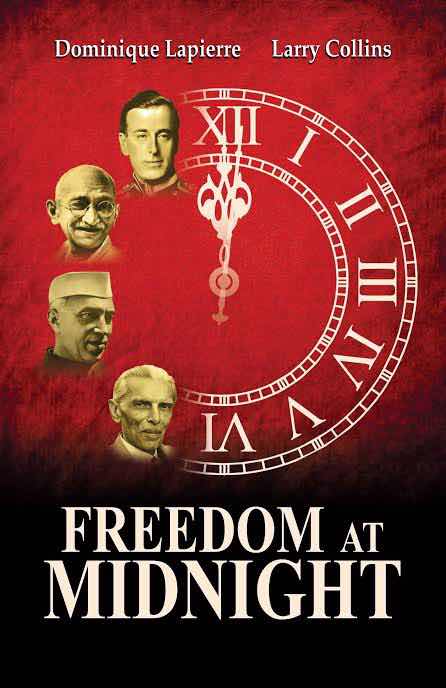
2) Freedom at Midnight:  
Probably the most famous book on partition, written by Dominique Lapierre and Larry Collins, this book is sometimes criticized to be biased towards the Britishers. But I found this book interesting to read. The book is based on extensive interviews conducted of the last Viceroy Mountbatten, his family members, and several other people. So it does seem to be telling the story from foreign eyes, but still it has thrown great deal of light on the partition issue. It has explained how the Indian politicians (including Jinnah) could never come to an agreement, which led to prolonged discussions. The book also tells the interesting fact about why partition was declared exactly at midnight. It also explains, with how much difficulty the exact partition lines were decided between India and Pakistan by "Cyril Radcliffe". And also, interestingly, the division demarcation was never disclosed till partition day. So on 15th August 1947, no one actually knew whether they were geographically in India or in Pakistan. The book also details about the lavish lives of princes of the princely states. It explains how the individual princely states were convinced to merge into India or Pakistan, leaving their hold on power. All in all a great book to learn about partition. A more detailed review of this book can be read here.

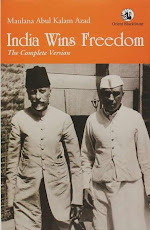
3) India Wins Freedom: 
Probably the best book, and should be must read for anyone trying to learn more about partition, and pre-independence politics. Written by Abul Kalam Azad, this book is special because the author remained Congress President for almost 6 years post 1939, and was involved as a representative of Congress in most talks/negotiations with Britishers- Cripp's Mission, Simla Conference, the British Cabinet Mission resolution etc. So he has given a kind of inside view of the negotiations going on in those times. He has also been pretty impartial about discussing the policies of Pandit Nehru, Sardar Patel and Gandhi ji. He has criticized several decisions of Gandhiji and has clearly written that majority of Congress politicians were with Gandhiji NOT because they believed in non-violence, but because they believed that non-violent ways of protest was the best and fastest way to get Independence. In fact there was a moment when many Congress politicians were in favour of going against Britishers taking violent path. Regarding Gandhiji's murder, he has written in very detail how the conspiracy was hatched and multiple assassination attempt were taken. He has criticized Sardar Patel (being Home Minister) for willful negligence about Gandhiji's security. A large part of the book focussed on several political negotiations with Britishers about getting Independence, and that really throws a great deal of light on what all transpired, why those negotiations failed, and why ultimately the Partition had to be conceded. The most painful part he has discussed in the book, is the betrayal done by Congress towards Khan Abdul Gaffar Khan, for not supporting their plea of demanding to keep the NWFP region in India. He wrote that Khan brothers had always been loyal supporters of Congress, but Congress and Gandhiji ditched them in such an important moment. After their region went into Pakistan, both the Khan brothers were jailed and tortured in Pakistan. In short, a really great book to read. The Font and Font size/spacing in the hardcover book available, makes the book slightly painful to read, but for it's content, one must not miss it.
4) The Shadow of the Great Game : The Untold Story of India's Partition :  Again a very exhaustive book, writing about things in very detailed manner. The author "Narendra Singh Sarila" had been ADC to the last viceroy Luis Mountbatten. Being ADC to the viceroy he must have seen things from close, hence his account seem very reliable. The Bollywood movie "Partition :1947" is based on this book. In this book, the author has argued that the partition was done by Britishers as part of much larger conspiracy to maintain hold over this part of Asia. The author has discussed things from the ongoing world politics at that time, and has thrown light on the Russian Vs Britishers fight for geographical supremacy. He has also brought in the viewpoint of maintaining control over rich Oilfield regions. The author's main viewpoint has been that Britishers were willing to leave, but wanted to take back a guarantee that the new, independent country will always support Britain in it's pursuit of increasing or maintaining hold over geographical locations through violent means (if it comes to that). Indian politicians were clearly in no mood to support Britain in any of their motives post independence. But the Britishers gauged the fact the Muslim politicians led by Jinnah were willing to give them this kind of logistic support for their military pursuits. The author was also of the view that the northern parts of India (NWFP, and Gilgit regions) were really important to Britishers for strategic reasons of halting Russians advances. This book is also very important to read the Jammu and Kashmir part of the story. The author has written in detail about J&K aspect, how the state was attacked by first Pakistani military led by British army men, and how they had captured some regions of J&K initially. And how the tribal led invasion was later undertaken by Pakistanis, which forced Raja Hari Singh to write a letter giving consent to merging of the state with India, in exchange for protection from Indian Army. The author also details how India made some mistakes of going to UN at wrong time, when they could have actually taken back the area of J&K captured by Pakistanis. United Nations headed by Britishers and Americans, were clearly biased against India's interests, was what the conclusion of author.                                     
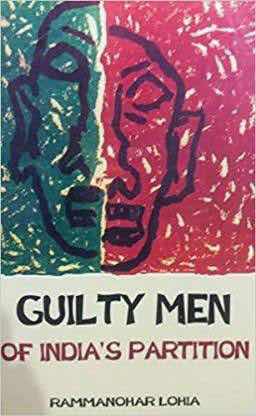
5) Guilty Men of India's Partition: 
This book by Mr Rammanohar Lohia is primarily a critique of the Book “India Wins Freedom” (a kind of critical review of that book). This entirely revolves around countering the facts and statements written in that book. As a result this book is very short and should be read only after reading "India Wins Freedom". After reading the book, I  couldn't stop at marvelling what a visionary Rammanohar Lohia was! Many of his views still stands true and will stand true in times to come too. In criticizing the view of Maulana Azad he wrote quite many of his own independent views/assessments too. Primarily in this book, he keeps the focus on Pandit Nehru, tries to prove that Nehru was the main person from Congress side who should take the blame for India’s partition. He also illustrates one incident where Nehru conspires through Jayaprakash Narayan to put the blame of Mahatma Gandhi’s murder on the carelessness of Sardar Patel (Lohia’s own assumption here).  Maulana Abul Kalam Azad in his book, had written the opposite. He had put the major blame of partition on Sardar Patel and towards the end he also blamed Sardar Patel's for Gandhi’s murder! So this book of Rammanohar Lohia is a must read for anyone who has read “India Wins Freedom”. It throws its own perspective on the happenings in pre-partition times, and some very interesting and enlightening ones! A few of his conclusions and presumptions seemed over the top and untrue. He hardly wrote anything about Sardar Patel, and he also skipped how/why Gandhi agreed to partition proposal, despite raising the point countering Maulana Azad’s view in his book. Comparatively, Maulana Azad in his book, had written about both Nehru and Patel, how they both had agreed to partition. His assessment had seemed more logical. Lohia’s assessments seem driven by prejudice (one sidedness) against Nehru or against the inaction of Maulana Azad for being inactive in stopping partition. All in all, I think since this book was written as a review of “India Wins Freedom”, it should be taken with a pinch of salt, with a limited purview of  a supplementary book to “India Wins Freedom”.


6) Indian Summer: The Secret History of the End of an Empire:-
As the cover photo itself suggests, this book heavily focuses on Mountbatten-Edwina-Nehru’s relationships. The author goes to a great extent to prove that Edwina and Nehru were in love. A few instances have also been cited where Edwina was able to influence Nehru’s political decisions. So on that part, it did well. There is a good dedicated chapter on Kashmir issue too. All in all, a very good book with some very interesting facts. What I didn’t like about this book though, is that more than half of the book (370 pages), was dedicated to exploring personal lives and family trees of Mountbatten, Edwina and Nehru. It does it so much, that sometime I felt as if I was reading a fiction novel!! I also felt that the author’s views came a bit biased at times. Being a britisher, she seems to have looked at events and decisions from a British perspective. But that’s not a big issue I feel, every author will be supposed to have some bias which we need to filter out as a reader. But all in all, a very good book to enhance the knowledge of partition. Every new book throws a new perspective on partition, and I am sure this book too does a great job at that! 
7) Midnight's Furies:- The prologue of this book reads-
 
"This book aims to answer a different question- not why the subcontinent was split, or who was to blame for the massacres, but how the experience of partition carved out such a wide gulf between India and Pakistan. How did two nation with so much in common end up such inveterate enemies so quickly"
And I think the book does that task pretty well. This books stands out in the way it throws light on the India-Pakistan conflict post partition, which laid ground for such a long persisting acrimonious relationship between the two nations. Almost the whole of last 4 chapters of the Book, is focused on detailing issues and conflicts revolving around the three contentious regions- Junagadh, Hyderabad and Jammu & Kashmir. And this was the first book I read, in which their strategic inter-relation is emphasized so well. Essentially, after partition, these three were the states which were undecided ones, and it was a matter of prestige and ego, for Pakistan to have these, and a matter of security concerns for India, to have it made part of India. A lot has been written on this, as to how both countries tried to make all the three their own. Ultimately, India was able to take Junagadh and Hyderabad, and Jammu & Kashmir ended up in stalemate. The matter of Jammu and Kashmir too has been written about in great detail. So this book did this part really well. Apart from that, the Book has also written in detail how Muslim League initiated trouble with call of Direct Action Day, and also about the role played by Hindu extremist organizations like RSSS in the aftermath. The gory detail of rioting and genocide in Punjab region too has been written about in great detail. And lastly, the book has pointed out in great detail the difference between the ideology and working style of Pandit Nehru and Sardar Patel. At several points it has contrasted their ideology and working style, basically showing Nehru as more liberal, idealistic person, and Patel as a bit of orthodox, religion centric person. There has been several instances mentioned where Patel had worked sneakily (as Home Minister), keeping Nehru in dark, because he understood Nehru would have never agreed with his actions. So in this aspect too, the author has written so well.    All in all, a great book to read.

remembering partition
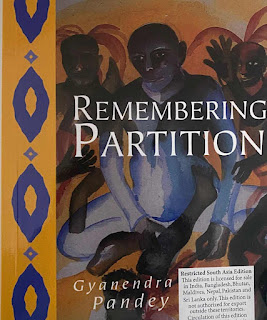
8) Remembering Partition:- This Book is not for beginner readers of India's partition. This book focuses almost entirely on the violence surrounding partition times - starting a few months prior to partition, and onwards. The title of the Book is a bit misleading, in the sense that, it doesn't give any information about the cause of partition, or the political events and decisions surrounding partition. It could have been better titled- "Remembering the Violence around Partition". Basically, the author assumes that the reader has already enough knowledge of India's partition, why it happened, how it happened and all the political events surrounding it. And starting from that assumption, this author focuses only the violence around partition and how they have been covered in various historical Books. The author picks up several examples of violence, and mentions several interviews of people who have lived those times, and tries to analyze the sociology and mindset of people during those times. The author also tries to analyse how those violence and the statistics about them have been reported by various Books, committees. As per him, most stats were exaggerated, biased or based on hearsay, rather than based on first person accounts. He also tries to analyse how people who have lived those times, and are alive now, talk about those events. As per him, most people claim that those incidences of violences never happened in their region, and in stead in some other adjacent area! The author also analyses various claims and counter-claims by both sides, and try to analyse who tried to say what, for which reason. More detailed review of this book written by me, can be read on the Book's Goodreads page here. I found it a great Book on India's partition, giving a different and unique perspective into the violence of those times. A great book to read, but not a must read.

9) Partition : The Story of Indian Independence, and the Creation of Pakistan (posted date- 30/11/2023)
This book by the British author Barney White-Spunner, gives a very good picture of the whole partition saga. Bring a britisher, he has mostly relied on British sources, and he has also looked at events from British point of view, but even then, this Book provides a very good insights into the whole set of events surrounding partition.
In particular, the Book manages to treat the subject of Congress Vs Muslim League very well. For ex, it comments on how Nehru and Gandhi were bereft of Ground realities about the religious strifes. 
The author says-
"Nehru's problem, as a highly educated, well-travelled socialist, was that he thought religion was irrelevant. To him India's problems were economic and social, with religion merely an excuse used by various groups to further their own economic position."

And about Mahatma Gandhi, the Book says-

"Gandhi also, although deeply religious, was largely agnostic as to creed and believed that much of India was a like-minded community of small farmers and peasants, meaning that Congress was becoming dangerously ignorant of how deeply religion actually mattered to the vast majority of people. In particular, it meant that they failed to appreciate the depth of belief that Islam engenders, the strong communalism of groups such as the Sikhs and the strength of the Hindu Mahasabha."

This Book also explains in good detail the carnage that followed partition and their causes. Most of all, this Book throws a new fact by claiming that most of the post-partition violence could have been controlled, had British forces been used against the murdering mobs. Indian forces being biased on both the sides, had become unreliable, and British forces were not used against Indians, because they were decided to be kept in reserve only to provide security to Britishers in India. Also, Mountbatten thought that using British forces against Indians post partition (even though they were part of Indian Army), would have caused resentment of Indians against British Govt. For the decision of not using the British forces against the rioters, he primarily blamed- Claude Auchinleck- the British Commander-in-Chief of the Indian Army (pre-1947). As per the author-

Yet ultimately Auchinleck allowed sentiment to cloud objectivity. Armies exist to serve the needs of the societies that generate them and the governments that represent those societies.

They do not have, nor should they have, any pretension to being an independent entity. They must also reflect the changes that society undergoes...... He loved India and was loved by Indian soldiers, but as a man who wielded enormous power, power on a scale which few if any British senior officers have exercised since, he could have done so much more to prevent the tragedy of 1947.


The Book also covers the J&K conflict in great detail. It explains well the conflict of Nehru on this, how he thought that Pakistan used Junagadh as a trap (Junagadh, J&K and Hyderabad were the only three regions which still remained independent well past 15 Aug, 1947). Being a military officer himself, the author seems to have taken keen interest in elaborating J&K incident from military angle as well, as to how it was defended by Indian Army. The detail are pretty graphical, and intriguing to read. There are some facts he missed covering on this though. In one other book I read, there was a clear mention of British military officers which were part of Pakistani forces, having been involved in the J&K incursion. He has mentioned only one detail about involvement of a British military officer, that too with very sketchy detail. But I have read about it in two other Books. May be the author handled up that specific aspect in a little biased way. But despite that, the J&K conflict has been discussed in great detail. Must read that part.

All in all, the Book was a great read for me. I got several new facts, and some really nice insights into the pre-1947 situation of Indian polity.


10) Jammu & Kashmir: Dilemma of Accession (posted on 10/12/2023)

This Book primarily focuses on the J&K accession issue, but also talks shortly about the partition issue in the beginning. The basic point of this Book is to discuss why were J&K rulers not willing to accede to India, and why they dithered so much. The Author has primarily blamed Gandhi and Nehru for the issue, and has let go Patel lightly. While many of the views of the author seem motivated and myopic, the Book does throw some great insights. The Book is based on the writings of Smt Lila Bhan- the daughter of the then J&K PM Pandit Ramchandra Kak. Her writing in turn is based on the diary writings/notes of her father, and both these writings have been used by the author Radha Rajan, to write this Book, appending some of her own views. All in all, a good read, gives a new perspective to the J&K issue.
Full Review in a separate blog-post here.


In Fiction
1) Train to Pakistan:- Khushwant Singh has written such a realistic fiction that one gets completely drawn into the story. It seems also quite close to reality, going by the narratives of other non-Fiction books read. Must read to realize the horror of partition through a gripping story.
2) Toba Tek Singh:- Saadat Hasan Manto writes stories so real-life and gripping, that you can relate well to it. He was much ahead of his times. This is a story book containing several short stories based on society and people of pre-partition times. Again a very nice book which gives a quick glimpse into the lives of people in pre-partition times...

Have you read any of these books? Let me know your thoughts. Which else books you have read related to partition, and found to be good? Please let me know in comment section
.     

October 16, 2017

The Funny online Selling Experience

So this was almost 2 yrs back when I wanted to sell my creative 2.1 speakers. The selling experience was both amusing as well as frustrating at times. I posted the ad with photos on two of the popular online websites. I installed their apps too, so that I could respond to any messages quickly. A few of the conversations with prospective buyers were so hilarious that I can still recall them vividly. One buyer had called me asking about the speakers, and after usual few questions, he asked- "Are the speakers having lengthy enough cords, so as to place them in different corners of the room". I was like, 'does this guy even know how 2.1 speakers are like!!' But I calmly replied that these are 2.1 speakers, and not meant for getting placed across the room.
Another buyer called and asked if the speakers have 3.5 mm audio jack. When I replied in affirmative, he asked if it will work with his Samsung phone which apparently didn't have 3.5mm audio output!
One caller asked me to lower the price being quoted in ad. I had already kept the selling price close to half of the current market price since it has just been 1 year for the speakers. When I told him that I don't want to sell it at any price lower than mentioned, he replied- "But several other 2.1 speakers are being sold at much lower price." I was like, "Oh, so all 2.1 speakers are same!"
There was one instance when a girl (or may be a buyer with female name) messaged me, and wrote-
"Heyy, do you want to sell this item?"
I replied- "No, I am just testing the selling feature here."
She:- "I too am new to buying here. Can you help me buy a good 2.1 speaker system?"
Me:- "Yes of course, you can buy mine."
She:- "But I actually want to buy, not just indulge in testing". I repented my first reply, and somehow brought the conversation back on track and explaining about my 2.1 speakers.

Another day, I got a message in my selling website's inbox, and started chatting with the buyer. Here is how the conversation went on:-

Buyer : "Hi, May I know why are you selling your speakers?"
Me: "Because I want to buy a better one."
Buyer: "Is it working fine?"
Me: "Yes".
Buyer: "Then why are you selling it?"
Me: "I told you, because I want to buy a better one, and I need money for that."
Buyer: "Which speakers are you thinking to buy?"
Me: "Haven't fully decided yet, but why do you want to know?"
Buyer: "May be I too will buy the same speaker, if good enough"
Me: "Do you want to buy my speakers or not?"
Buyer: "Yes, yes I do."
Somehow, we agreed on the price and then I asked for the location of exchange. 
Me: "So where do you want to meet for taking the speakers?"
Buyer: "Anywhere in Jammu city."
Me: "WHAT!! You are from Jammu?"
Buyer: "Yes, I thought you too are from Jammu."
By now, I was frustrated as hell,but somehow persevered.
Me: "Sorry, then no point discussing. I stay in Hyderabad."
Buyer: "Heyy, By any chance, can you courier the speakers?"
Me: "Yes I can, if you pay the additional courier charges"
Buyer: "Ok, please courier then. I will transfer you the money as soon as I get the courier."
This was the limit of my patience.
Me: "Good Bye", and I blocked the person.

Now, after so many months of the experience, when I came across the Cashify.in website, I found it to be a very promising website for selling old electronic items.

Disposing of e-waste is another big issue that can be solved by such initiatives. Many times, we don't sell our electronic items, because of the hassles involved in selling. With such hassle-free experience of selling, with no negotiations and haggling involved, I think cashify comes up with a very great initiative. #CleanUpCashOut is the mantra, i.e. you clean up your old electronic items, and you get cash out of it! You can know more about the cashify, by watching these two videos- Video1, Video2.  Use coupon CLEANCASH and get an additional Rs 250.

December 26, 2016

The losing Compassion and Empathy...

Image Source:- lonelyplanet.com
Sometimes you do something and immediately after that realize the mistake. But by the time you realize it, you also realize that you can hardly do anything about that. So a sense of guilt encompasses you, a guilt which you can't do anything about! 

Today while coming back to my flat, a poor couple on road, with a kid in the arms of mother, stopped me and pleaded for money. This is fairly common scene in Hyderabad, and I immediately ignore and brush past such people. But this time, the guy called back saying he doesn't want money, even food will be great. I had almost moved ahead, when I recalled that my this month's quota of helping people in need was still pending. So like a shrewd businessman I smelled an opportunity there- an opportunity to fulfill my monthly resolution, an opportunity to get some instant gratification. I turned back, told the guy to come with me and I will buy them Dinner. I signaled them to cross the road with me to the other side, where I knew an affordable restaurant. I went there asked the person on reception, to pack a dinner for two. I paid for that, took the packed food, and handed it over to the guy standing outside the restaurant. That's where I did what I immediately felt guilty about.  While handing over the food packet to the guy, I showed great hurry for leaving, didn't even look towards the guy, and quickly instructed him to move away from the place (so that he doesn't cause trouble to the restaurant owner). All this while he was politely thanking me for the food!! The moment I moved away from them doing all this, I realized my mistake! I realized my mechanical nature, my inhumane approach towards the family, my selfish nature to fulfill my resolution without caring for the intent. But the moment had passed, there was no going back, I could hardly do anything about that. I was in hurry to reach my flat, but once I decided to buy them food, I should have done that with a sense of empathy. That empathy was missing, that humane nature was missing. I did that as if I was doing a favor to the family, with no emotions, no humane connection with the family! Particularly, the hurry shown while leaving them, put myself to shame. I might have helped the family, but the intention of helping was missing. I immediately felt a pang of guilt, which I felt so helpless about. I just promised to myself to do better now onwards... 

The incident made me think, why have we become so mechanical and so self-centered in our life? We are we always in so much of hurry, that we forget there are other humans around, some of whom may need our compassion and empathy, much more than anything else! Money seems such an easy way out. Spend some money and suppress the need of helping with compassion! Where are we headed! Life seems moving so fast that we don't even want to stop think about the pain and suffering of others....

December 18, 2016

The Journey of Life...

Image Credit:- andriathompson.wordpress.com ( http://tinyurl.com/j3rkxld )
So busy we get in our life, that we forget to ponder on it, reflect on it...
the various hues and the shades, the various ups and the downs, seem to have been dumped deep down in memory.
Things that used to matter most, seems to have went into oblivion...
people who used to be omnipresent, seems to have moved on to different world.

As our life keeps expanding to the wider horizons, our earlier, closer connections with things and people who used to matter earlier, keeps on waning...
newer people and newer set of things make entry into our life, grabbing space in our already cluttered life.
Can't we stop, take a breath, observe, look back at life, and contemplate over things happening around? Can't we take a break every once in a while to think over our life's happenings? Are we prioritizing things wisely, are we spending our times judiciously, are we bringing good changes around us, are we being humane? Can't we think over things that matters most in life... 

November 20, 2016

Demonetization: How good is the move ?

Image Source:- http://www.countercurrents.org/ ( http://bit.ly/2g6p4Sy )
Several good steps have been taken by the current Central Govt, but the two major decisions that will be remembered for long, are the Surgical Strike on Pakistani terrorists in POK, and the current demonetization of Rs 500 and Rs 1000 notes. While the demonetization being termed as "Surgical Strike" on black money was a bit too much, but then it does seem to be a great idea. However, there are several other things which need to be pondered upon.

Initially, the sudden announcement of demonetization came as a shocker but a pleasant one. The most surprising and appreciable thing was the secrecy with which the entire plan was put into action. But then, what came next was shocking! The ATMs were announced to be out of service for 2 days. So it was expected that they will start working from the third day onward. But forget third day, the ATMs remained out of cash, even after 7 days!! There has been utter chaos for cash. All this thanks to the horrible implementation by the Government. They first banned use of notes, and then started printing new notes. None of ATMs had anything other than Rs 100 notes, which drastically decreased the vending capacity of ATMs. The new Rs 500 notes were not even available with banks, they were still under printing. The Rs 2000 notes were so out of dimensions that they couldn't be made available in the current ATMs. So Govt first banned the notes, without making the equivalent notes available with banks/atms. Needless to say, the great looking idea was spoiled thoroughly and forced Govt to head to disaster management tactics!

But talking of some major issues:-
  1. Do I welcome the demonetization idea?
  2. Will it ensure development?
  3. Do I appreciate the efforts put that went into implementation and planning?
  4. Will it reduce corruption and black money?
1. First, Yes I absolutely welcome the idea. The idea in it's core looks great. If it will not curb corruption or black money much, at least it will definitely kill the counterfeit notes in circulation completely. 

2. Will it ensure development? Quite an unrelated issue, but I think it won't affect development much. Removal of counterfeit notes, and curbing black money to some extent, it will surly boost development for a period, but then after some time, development will hinge on the core issues. On the other hand, development may even slow down for the near future. There are already news of GDP growth rate likely to go down in coming quarters.

3. Do I appreciate the efforts and implementation plan? Absolutely not! What initially came as a great plan, later turned out to be a horrible mess. Come on, which Govt first bans notes, and then starts printing them! What was Govt even thinking! On top of that, this situation of chaos is going to remain for significant number of days. When PM himself has asked for 50 days, you can very well understand what is going to happen. For 50 days or more, there are going to be severe restrictions on withdrawing of your own hard earned money from Bank! Why should Govt block your money from getting withdrawn! There can be several issues for which one can need cash in lakhs, which one can't withdraw even if he has enough in his own account, all legally earned. Already, there has been news of some deaths due to the chaos. So it's quite apparent that the great looking idea was turned into a disaster.

4. Will it reduce Corruption and Black Money? Corruption- absolutely not. Black money- Yes to some extent definitely. Corruption will continue with new notes, I think corruption has hardly got anything to do with demonetization. The Black money though, will certainly be reduced to some extent. Even though most of the black money is either invested in properties or other non-cash items like Gold, whatever black money is there in cash, those are definitely going to be curbed. There are news of black money getting turned white through various clever means, but even despite all those tricks, a significant amount of cash black money will definitely be reduced.

All in all, a good move, but with horrible implementation. It could have been far better, had Govt prepared better for the big decision. With so much of inconvenience to public, it doesn't come out to be a great thing to happen. For catching 1% of people, Govt is troubling 100% of people, in some cases, threatening the lives of innocents, so all these take the sheen out of this great looking idea.

November 07, 2016

Freedom at Midnight: Some thoughts on the Book

Image Source:- amazon.in
What went wrong, Mountbatten admitted to us, was this sheer, simultaneous reaction which nobody foresaw. No one predicted millions of people would pull up stakes and change sides. No one. 
Partition has always been an intriguing event for me, probably more intriguing than the freedom struggle. What happened that led to partition despite some prominent leaders opposing it till the end. What went wrong that partition led to loss of lakhs of precious lives, and forever bitterness between people of the two nations? These questions always kept nagging me from time to time. And that was the reason, even though I seldom read non-fiction books, and hardly have any interest in historical books, slowly I started reading partition related books. The first one was, “Pakistan, Or the Partition of India” by Dr. B.R. Ambedkar, second one was “Train to Pakistan” by Khushwant Singh (the book is a fact inspired fiction), and the third one is this “Freedom at Midnight” by “Larry Collins and Dominique Lapierre”. 

The Book is probably one of the most popular, and one of the most extensive account of the partition, and in a most captivating way. Primary, it has focused on below few issues:-
  1. What led to partition? Why did partition become inevitable?
  2. Mahatma Gandhi's life, and his efforts in bringing together peace in the pre and post-partition times. Also, why all his efforts failed to stop partition.
  3. The efforts and events that went into division of Punjab and Bengal, into Indian and Pakistani area. 
  4. The widespread riots and violence in pre and post-partition times and the reasons behind them.
  5. The hundreds of princely states of India, and the detail of efforts that went into forcing them unite them into either India or Pakistan.
  6. The detail behind the murder of Mahatma Gandhi by Godse and his accomplices.
On Partition
The biggest reason of partition, was the rise of Jinnah as one of the most formidable power among Muslims. Among Muslims, he had as much popularity as probably Mahatma Gandhi had among Indians. But of course he was exact opposite of Gandhi in nature.  He had literally held Indian leaders to ransom, under threat of widespread violence by Muslims under his command.
Quoting from the Book:-

In a tent outside Bombay in August 1946, he had evaluated for his followers in the Moslem League the meaning of Direct  Action Day. If Congress wanted war, he declared, then India’s  Moslems would ‘accept their offer unhesitatingly .
Pale lips pressed into a grim smile, his piercing eyes alight with repressed passion, Jinnah had that day flung down the gauntlet to Congress, to the British. ‘We shall have India divided,’ he vowed, ‘or we shall have India destroyed.’ 
Such was his devilish nature! Why he turned into someone like this, and how he was able to turn a large Muslim population against Hindus, is another matter and that Dr. Ambedkar has dealt with better in his book on partition. But needless to say, Jinnah was the biggest factor for partition. In fact, it has been mentioned in the book that, Jinnah was suffering from a critical illness at the time of partition discussions, and was counting his last days, but this was a top secret. Had this fact be known to them, the last viceroy Mountbatten and Indian leaders, would preferred to wait for him to die, so that partition could have been avoided! 
Apart from Jinnah, another reason was that the patience of Indian leaders was running out. They have had enough, they just wanted freedom from Britishers as soon as possible. And Britishers led by Mountbatten, didn't want to leave without a proper system in place here!! Interesting fact is that, had Mountbatten not been sent to India, there was a chance that partition won't have happened. Because the predecessor of Mountbatten, Lord Wavell, had no plan to put in a system in place before leaving. Funnily enough, he had a plan named "Operation Madhouse". :) Quoting from the Book (Lord Wavell talking to Mountbatten):-
‘This is called “Madhouse”,’ he explained, ‘because it is a problem for a madhouse. Alas, I can see no other way out.’  It called for the British evacuation of India, province by province, women and children first, then civilians, then soldiers, a move likely, in Gandhi’s words, to ‘leave India to chaos’.
One more reason was the lack of time for decision making. During those times, the Hindu-Muslim divide was getting wider. There was widespread violence every now and then. On the "Direct Action Day" call of Jinnah in 1946, there had already been bloodbath in Bengal. Mahatma Gandhi's peace calls used to be temporary and were not effective for longer times. Jinnah was always on lookout for adding fuel to the fire. Leaders were clueless how to put things in control. Everyone agreed that some decision had to be taken, and it had to be done quickly. So in that haste, they went for something, which aggravated the situation rather than pacifying it. Essentially, everyone miscalculated the mood of millions of population. 

On Mahama Gandhi   
A great portion of the book is devoted to Mahatma Gandhi, his life, his ideals, his efforts to keep India united, and why his efforts failed.
Unlike popular perception, Mahatma Gandhi fought till the end to keep India united, and avoid the partition. That he failed in his efforts is another matter.
Quoting from the book:-
So desperate was he to avoid partition that he was prepared for a Solomonic judgment. Give the Moslems the baby instead of cutting it in half. Place three hundred million Hindus under Moslem rule by asking his rival Jinnah and his Moslem League to form a government. Then hand over power to that government. Give Jinnah all India instead of just the part he wanted. He could not budge Nehru and Patel. There was a limit to the price they were prepared to pay to keep India united and handing over power to their foe, Jinnah, transgressed it. They did not share Gandhi’s conviction that partition would inevitably lead to terrible violence. Broken-hearted, Gandhi would have to report to the Viceroy that he had not been able to carry his colleagues with him. 
Finally, Mountbatten held parleys individually with Sardar Patel and Nehru, to convince him on partition, and they agreed. Two of their crucial men going against his opinion, Gandhi was broken and felt helpless. He was also not sure how the common Indians will respond to his calls for opposition to the partition. Mountbatten also tried to convince Gandhi through all means, and was able to somewhat subdue his resistance. But in a nutshell, all Congress leaders turning against his opinion, was the breaking point for Gandhi. Quoting his own words from the book:-
‘They call me a Mahatma,’ he bitterly told a friend later, ‘but I tell you I am not even treated by them as a sweeper.’ 
Another quote deserves a mention in the same regard:-
Walking the streets of Delhi early one morning, one of his workers said to him: ‘In the hour of decision you are not in the picture. You and your ideals have been given the go-by.’
Yes, Gandhi sighed bitterly in reply: ‘Everybody is eager to garland my photos and statues. But nobody wants to follow my advice.’ 
Gandhi's life and ideals have always been controversial. The book also touches upon one major aspect for which Gandhi ji is criticised heavily even now - his views on sexuality, and why he used to sleep on same bed with his 19 yr old great-niece "Manu". The book gives Gandhi's perspective on those practices. (These views were actually views as told by Gandhi's personal secretary Pyarelal, and his Doctor Sushila Nayar). It also touches upon other related aspects like, why he used to get massaged by female followers, why he used to walk hands on shoulders of the two girls Manu and Abha. (All these were related aspects).
Even though I don't agree to his practices on this issue, his rationality behind it did make some sense, although it didn't look a practically possible thing to imbibe. I am quoting the related text from the book:-
As his confidence in the mastery of his desires came back, he gradually extended the range of physical contact he allowed himself with women. He nursed them when they were ill and allowed them to nurse him. He took his bath in full view of his fellow ashramites, male and female. He had his daily massage virtually naked, with young girls most frequently serving as his masseuses. He often gave interviews or consulted the leaders of his Congress Party while the girls massaged him. He wore few clothes and urged his disciples, male and female, to do likewise because clothes he said, only encouraged a false sense of modesty...... For Gandhi, secure in his own conscience, there was nothing improper or even remotely sexual in his relations with Manu. Indeed, it is almost inconceivable that the faintest tremor of sexual arousal passed between them. To the Mahatma, the reasoning which had led him to perform what was, for him, a duty to Manu, was sufficient justification for his action. Perhaps, however, deep in his subconscious, other forces he ignored helped propel him to it. 
Boundary division of Punjab and Bengal by Cyril Radcliffe

This is probably the least discussed issue on partition, but is most crucial in a way. When partition was agreed, exact boundary and which princely states will go to which Nation, were not decided. In fact the surprising fact is, even on the day of India's freedom, the India Pakistan boundary lines were not announced. There were two major tasks, deciding on which princely states will go to which nation, and then deciding the boundary of the two nations in Punjab and Bengal. These two areas were very crucial, because they contained a great mix of population and interdependence on one another. For sake of neutrality, Cyril Radcliffe, was invited from Britain, to decide on the exact boundary. In the end, the partition in Bengal didn't cause any issue, but the boundary division announcement in Punjab, led to great bloodshed. Population transfer took place in millions, and there was immense bloodshed.

The riots and situations surrounding them, have been dealt in great detail in the book. The princely states, the lives of their princes too have been described in great detail. Most of the princely states wanted to get total independence, rather than going with Pakistan or India. How they were forced to merge with either of the Nations, is another aspect dealt in great detail. Some of them were convinced, some were blackmailed, and some like Raja Hari Singh of J&K was conditionally convinced under foreign attack pressure. The Pakistani tribal led attack on J&K too has been explained in detail, explaining how it ended up with the agreement with Raja Hari Singh. The book ends up with devoting another great portion on the murder of Mahatma Gandhi. 

If not for anything, one must read the book for the unbelievable real-life love story of Boota Singh and Zenib. A Sikh-Muslim love story leading to marriage, then cross-border run, court cases, suicide and Muslims supporting the Sikh guy's wishes post his death. The story will put even the modern day bollywood Indo-Pak love stories to shame.

**************************************************************
In the end, I would like to put two more quotes from the book on two crucial issues:-


When Sardar Patel and Pundit Nehru turned against Gandhi's idea of United India:- 
Patel had been prepared to concede partition even before Mountbatten’s arrival. He was ageing, he’d suffered two heart attacks, and he wanted to get on with it, to end these ceaseless debates and get down to the task of building an independent India. Give Jinnah his state, he argued, it wouldn’t survive anyway. In five years, the Moslem League would be knocking at their door begging for India’s reunification.
Nehru was a torn and anguished man, caught between his deep love for Gandhi and his new admiration and friendship for the Mountbattens. Gandhi spoke to his heart, Mountbatten to his mind. Instinctively, Nehru detested partition, yet his rational spirit told him it was the only answer. Since reaching his own conclusion that there was no other choice, Mountbatten had been employing all the charm and persuasiveness of Operation Seduction to bring Nehru to his viewpoint. One argument was vital. With Jinnah gone, Hindu India could have the strong central government Nehru would need if he was going to build the socialist state of his dreams. Ultimately, he too stood out against the man he’d followed so long. 

When Nehru, Patel lost control of the Nation after partition, and requested Mountbatten to take complete control again! 
For the next quarter of a century the results of the meeting beginning in Louis Mountbatten ’s study on the morning of Saturday, 6 September 1947 would be the most closely guarded secret of the last Viceroy’s life. Had the decisions taken at it become known, the knowledge could have destroyed the career of the charismatic Indian statesman who would emerge in the years to come as one of the world’s major figures.
Three people were present: Mountbatten, Nehru and Patel. The two Indian leaders were sombre, visibly depressed men; they looked to the Governor-General ‘like a pair of chastened schoolboys’. The situation in the Punjab was out of control. The migration was exceeding their worst fears. Now violence in Delhi threatened to bring down the capital itself.
‘We don’t know how to hold it,’ Nehru admitted.
‘You have to grip it,’ Mountbatten told him.
‘How can we grip it?’ Nehru replied. ‘We have no experience. We’ve spent the best years of our lives in your British jails. Our experience is in the art of agitation, not administration. We can barely manage to run a well-organized government in normal circumstances. We’re just not up to facing an absolute collapse of law and order.’
Nehru then made an almost unbelievable request. That he, the proud Indian who’d devoted his life to the independence stmggle could even articulate it was a measure of both his own greatness and the gravity of the situation. He had long admired Mountbatten’s capacity for organization and swift decision. India, he felt, desperately needed those skills now and Nehru was too great a man to let his pride stand in the way of her having them.
‘While you were exercising the highest command in war, we were in a British prison,’ he said. ‘You are a professional, high-level administrator. You’ve commanded millions of men. You have the experience and knowledge colonialism has denied us. You English can’t just turn this country over to us after being here all our lives and simply walk away. We’re in an emergency and we need help. Will you run the country?‘Yes,’ seconded Patel, the tough realist at Nehru’s side, ‘he’s right. You’ve got to take over.’Mountbatten was aghast. ‘My God,’ he said, I ve just got through giving you the country and here you two are asking me to take it back!’
‘You must understand,’ Nehru said. ‘You’ve got to take it. We’ll pledge ourselves to do whatever you say.’
‘But this is terrible,’ Mountbatten said. ‘If anyone ever finds out you’ve turned the country back to my hands, you’ll be finished politically. The Indians keep the British Viceroy and then put him back in charge? Out of the question.’
‘Well,’ said Nehru, ‘we’ll have to find a way to disguise it, but if you don’t do it, we can’t manage.’ Mountbatten thought a moment. He loved a challenge and this was a formidable one. His personal-esteem for Nehru, his affection for India, his sense of responsibility, left him no way of escape.
‘All right,’ he said, the admiral back on his bridge, ‘I’ll do it, and I can pull the thing together because I do know how to do it. But we must agree that nobody finds out about this. Nobody must know you’ve made this request. 

Ads