Showing posts with label Technology. Show all posts

July 03, 2016

How to remove MPC Cleaner software from Windows PC

I decided to write this blog-post because I never got the solution to this problem on any other blog. 2-3 weeks back this buggy software got installed on my system (Windows 10) while trying to install another software. And I have to confess, this took hell lot of effort for removal. Strangely this was not a standard virus, but more like an adware software which keeps luring you to click some links or perform some action.
Here is what started happening with all my browsers once this adware got installed:-


So two main issues as you can see in above screenshot:-
  1. My browsers will always start with the above default landing page. Later on I could close this specific tab, but there was no way to disable this thing. I tried resetting the browser, no effect. I even uninstalled google chrome, and installed again, still no effect. The reason for this was that it was able to do all this through entries in registry. So all the browsers were being controlled through valid registry entries.
  2. Another issue, with start up of OS, an MPC icon will appear in the right bottom expand bar menu (as shown in above picture). That application used to keep running. I was able to disable it after starting up, but I was not able to block this application from starting up with start of OS.
  3. Third issue was that time to time, it would show a pop-up suggesting optimization of PC using it's interface. I never tried optimizing but I am sure that must lead to more ads or redirect to installation sites. But the pop-ups were irritating like hell.
For two weeks I suffered with this issue-well actually not everyday , but definitely 2-3 days out of the past two weekends. Below are all the unsuccessful steps I took to remove the bugging software:-
  1. Of course the first step I took was try to to uninstall the program from the standard "Uninstall or Change a program" window of control panel. Quite shockingly, the software was not listed there. Some websites had mentioned that it shows to be installed with some other name. But I checked all the installed software, and there was not a single unknown/strange software showing up in the window! So the application was installed but it was not being shown in the list of installed software with any name! This is where Microsoft needs to take action. This is surly a windows OS fault. 
  2. Next step I took was that I installed various recommended softwares specifically meant for it's removal. Some of those were able to detect this application, but they asked for buying of full version in order to remove the MPC adware.
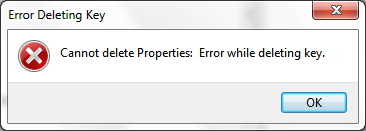
  3. Then I went by another recommended suggestion of deleting all the registry entries related to MPC. And lo and behold, it won't get deleted!! I got this kind of Error pop-up window while trying to delete them.
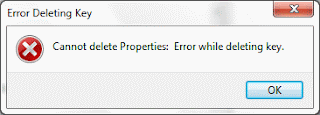
    I tried a lot to enable deletion, I checked the permission for that key, it showed me having full permission. Then I installed a software from Microsoft website which promised to solve this issue by making all key deleteable, but that too didn't work.
  4. I tried going to the C:\Program files folder and tried deleting the MPC folder or the files lying inside. I was not able to delete!!
  5. The I reached this website page where I saw suggestions by someone named "Jsssssssss". It looked reliable suggestion, so I tried them out. He had suggested to try removal using two of the softwares. Unfortunately that also didn't work. Those softwares were not able to force delete/remove the MPC application.
  6. But in the end, that very page gave me the solution. On the next page, another person with the name - "DIDiligentComputing" had given a solution which worked like a breeze for me! In fact, unlike asked by him, I need not run the computer in the safe mode.
The Solution: Removal of MPC software/adware
  1. Go to the Malwarebytes website. Download and install the anti-malware tool from there.
  2. It has a nice, cool interface. Start a scan using it's easy interface.
  3. It shows the step-by-step progress of the scan, as below:-
  4. After completion, it prompts you for action. It displays the count and list of detected suspicious software, and you can go ahead choose to delete them. And viola, the problem is solved!
    The best thing about this software is that it allows removal of such clever adwares in it's free version itself. It took a bit of time in scanning C drive (in this case above 2 hrs), but then it found more than 200 suspicious programs requiring to be removed! 
My big thanks to the Malwarebytes guys for creating this great anti-malware application and allowing it to be used for free for certain time-period.
Ending it up here. Hope this blog-post helps someone like me out there, troubled with MPC :)


June 05, 2016

Quick way to clear space on iPhone without any external app

I always face space crunch issue in my iPhone, and uptil recent past, I used to clear the space using an external app downloaded from app Store. But recently I came across a much better way of clearing space. It is through the inbuilt iTunes Store app of the iOS. Since this is pre-installed app on iPhones, so there is no need to install any other app. And clearing space  using this app, works more efficiently too. Actually, clearing space is not the purpose of this app, but somehow it works. It works when you try to download some large movie file from iTunes store, and you don't have enough space for that in your iPhone. It then gives a pop-up message and then goes to clear the local temp and cache files taking space in iPhone. Below is the steps I am detailing one by one:-


  1. See the initial screenshot above, which shows my phone having just 63MB space left.
  2. In the next step,  I opened the iTunes Store app. 
  3. In 3rd step (screenshot below), I open any movie of fairly large size, much larger than the suspected empty space eaten up by temp/cache files. In this case I chose a movie of size of about 4GB
  4. And then you have to click to download /buy the movie. Don't worry about the price of movie. It will never be able to download due to it's large size, so no chance of the money getting deducted. In my case though, I have no credit card connected to my account.
  5. After choosing to buy the movie, it will show this pop-up given below, which tells that there is not enough space on the phone, for this movie to be downloaded.
  6. Just click OK, and that's it!! Come out of the app. iPhone automatically starts clearing space taken by all major apps one by one. It removes temporary files stored by most apps. You can see the "cleaning" word written below some apps, while the process is on. After 2-3 min. check back the available space again in the settings page. The space must have increased. In my case, I was able to reclaim over 900MB of space.


 Note: This might be a temporary hack, and with further upgrade of iOS, it may stop working. But with the latest iOS version 9.3.2, it works pretty well.

April 13, 2015

Net Neutrality, Save the Internet Campaign, what's this all about

Image source: https://www.youtube.com/watch?v=0S1t54THJZY


What is Net Neutrality? 
It is simply an unbiased treatment of all kinds of data over Internet. Quoting from the consultation paper of  TRAI:-  
"Strict NN: NN prohibits TSPs from speeding up, slowing down or blocking internet traffic based on its source, ownership or destination.
According to Hahn & Wallsten, “NN usually means that broadband service providers charge consumers only once for internet access, do not favour one content provider over another, and do not charge content providers for sending information over broadband lines to end users.”
So how all this started?
3-4 years back, smartphone penetration was very low. With arrival of Android OS, smartphones' prices started coming down. At the same time, mobile application market too saw a quick boom. Suddenly everyone who could afford, had a nice smartphone in hand with so many mobile applications (apps) installed in them. 
While this meant a boon for consumers like us, the same gradually brought a big worry for Telecom Service providers (TSPs). The profit margins started coming down for them. With arrival of messaging apps like Nimbuzz, whatsApp, WeChat, hike etc. people with smartphones got a better option to sms and mms. Using these messaging services were far cheaper than sms/mms option. 
So the profits getting generated from sms and mms came significantly down for the TSPs. Similarly, arrival of calling apps like skype and Viber meant a great loss for TSPs again. International calling cards went for a toss, and even for National calls, many people on 3G started using these calling apps. As per the stats of TRAI, in the year 2003, skype’s traffic was almost 40% the size of the entire conventional telecom market, and in growth terms it has now far outpaced the combined growth in the voice minutes of the global telecom industry!! 

So you got that? Telecom Service Providers are crying over the loss in profits happening due the emergence of these messaging and calling apps. But there comes another point. Aren't these telecom companies earning more too, due to the rise in internet data consumption?  Is the rise in revenue on account of data packs, enough to mitigate the loss in profits happening due to decrease in revenue from sms and calls? Apparently not. Their argument is that, they have to increasingly keep upgrading the system to cater to the increasing demands of consumers, and they have to keep investing in new infrastructures at the same time. So all these additional expenses make it difficult for the revenue from data packs to mitigate the loss in profits due to the mobile apps. That's what the contention of TSPs is, and that's what TRAI also seems to be getting convinced with. 
So now TSPs are up in arms and are demanding various regulations in order to get compensated for their loss in profits. After having a meeting with TSPs and mobile app makers on the issue, TRAI thought the need for some regulations, but they wanted to take public opinion. So they came out with a 118 pages consultation paper explaining the issue in detail, and asking 20 questions on various aspects of the issue. 
Image source:- http://www.technotraps.com/net-neutrality-india/

The TRAI consultation paper basically focusses on 3 major issues:-
  1. Concerns raised by TSPs 
  2. The OTT app makers not bounded by Indian laws and regulations
  3. Security concerns related to the OTT (over the top)
From the tone and tenor of the paper, TRAI seems to be tilting more towards the cause of TSPs. Their argument- these app makers do a free ride on the network of TSPs, flourishing and earning huge profits without giving TSPs any portion of their profit. Funnily enough, TRAI has termed these mobile apps as OTT- Over the top- services, as if they are doing a crime by using data "over the top"! 
In the words of TRAI-
"The characteristics of OTT services are such that TSPs realise revenues solely from the increased data usage of the internet-connected customers for various applications (henceforth, apps). The TSPs do not realise any other revenues, be it for carriage or bandwidth. They are also not involved in planning, selling, or enabling OTT apps. On the other hand, OTT providers make use of the TSPs’ infrastructure to reach their customers and offer products/services that not only make money for them but also compete with the traditional services offered by TSPs. Leave aside TSPs, these apps also compete with brick and mortar rivals e.g. e-commerce sites, banking etc.


Paradoxically, the broadband networks provided by incumbent TSPs are used as a platform by the OTT players for the development of new businesses. The growth of traffic apart, the OTT applications have created an increasing demand for faster broadband speed, which translates into a need for huge investments in network up-gradation by the TSPs."
While giving all these arguments, they forget that TSPs are also earning revenue by way of increased data consumption. And if they are incurring significant loss in profits, then they can always hike the data pack prices accordingly.

But yes, as for point 2,3 related to Regulation and security, TRAI does have some valid point. None of the apps are registered in India, so they are not bonded by Indian laws or regulations. It can cause severe problem at some time. But forcing them to register may introduce unnecessary hassles along with delay due to underlying process and red tapes. Best would be that they be made to submit an affidavit giving information of their organisation and promising to follow a set of rules and regulations. The security concerns are also very legitimate one. Here too they could be made to sign similar affidavits legally binding them to certain laws. 

Here are a few policies/regulations which are being considered to be implemented by TRAI, and could become reality soon:- 
  1. Mobile app makers may be made to register with Indian authorities after paying certain amount of fee. 
  2. Mobile app makers may be made to adhere to certain quality of service, and to a set of Indian laws and regulations 
  3. Mobile app makers may be made to give a section of their profit to the TSP whose network they use. 
  4. TSPs may be given free hand in charging customers based on types of data. Like 5MB of data spent on voice calls using apps like viber or skype may cost Rs. 30, whereas the same 5MB data spent in surfing websites through browser could cost just Rs 10. A 10 MB voice call over skype may cost you much more than the same 10MB data spent in website surfing not involving any audio data transfer.
  5. TSPs may be allowed to selectively slow-down or speed up the access to some websites or apps. Like you could access flipkart faster than whatsApp (even though both may be requiring same amount of data to download). 
  6. TSPs may be allowed to make a few apps/sites free on their network and charge for other ones. In this scheme, the owner of app may pay money to TSPs per user per data being used and the TSP in turn may make the access free for users on his particular network. This means, that different service providers may have different free schemes. For example, Airtel may provide free access to flipkart on their network, Vodafone may provide free access to amazon on their network and so on. While this looks good in a way, but this gives preferential treatment to specific app makers willing to pay hampering a fair competition. This may also habituate users for a particular app or website, hence killing the concept of free choice.
All the above possibilities are not my assumptions or just inferences from some online articles. These are as per the document of TRAI. In the consultation paper, TRAI has clearly mentioned proposals to implement the above few policies. In fact there are many more proposals for new policies, but above 6 are the most crucial and noteworthy proposals which can completely change the way we access internet.

I am sure most of you would feel many of the above proposals to be extremely alarming. How would you feel paying different-different amount for different kinds of data and different kind of applications being used!! And how would you feel a few websites being slowed down, and a few accessible faster, even though being subscribed to a standard internet pack? That's why we need to make our voices heard, by protesting against these proposal which completely go against the idea of Net Neutrality. We should first email to TRAI (advqos@trai.gov.in), giving our response to the 20 questions asked. And then we should spread awareness about the same. We should write to our area MPs/MLAs to support this cause. 

That almost concludes my blog-post.

Below this line, I would be quoting a few very crucial excerpts from the TRAI consultation paper, which will give very clear indication of the way it is headed. Here it starts:-

Regarding revenue from consumption of increasing amount of data, this is what TRAI has to say:-
 
"At one extreme, some argue that TSPs should focus exclusively on their role as "bit pipes" (carriers of data through the pipes) rather than remain integrated companies that provide services and infrastructure. However, there is another side to the story. Building such networks will require substantial investments by the TSPs. With more users connecting to the internet, the network of the TSP is under constant strain and there is the risk that the back-end server will reach its capacity very fast, thus compelling constant upgrades, the costs of which are to be borne exclusively or for the large part by the TSPs which build such networks ."
 On revenue loss due to voice calling services, this is what the TRAI document reads:-
 "In voice services, however, a different situation arises where unmanaged IP voice services,such as Skype or WeChat or Gmail video chat, can be exploited with lower access speeds. This obviously and adversely impacts the revenue of TSPs. For example, every Skype call that bypasses the TSP is foregone revenue. Similarly the use of SMS services, traditionally a lucrative business for mobile operators, is declining. One of the main reasons is the growth of OTT applications like WeChat and WhatsApp."
Regarding lack of any licensing of the mobile apps, this is what the document reads:-
"According to the Cellular Operators Association of India (COAI), voice services provided by OTT players substitute the PSTN/ Internet Telephony Services offered by licensed TSPs. In the present licensing regime, Internet Telephony is a licensed service permitted only under the UAS/ISP or Unified License granted under Section 4 of the Indian Telegraph Act 1885. Hence, according to COAI, companies offering OTT voice services, without holding a telecom license in India, circumvent Indian telecom licensing provisions and provide services that are otherwise permitted only under a telecom license.

COAI further opines that the licensed TSPs in India are subject to many licensing provisions, including but not limited to regulatory fees such as Entry Fee, License Fee and Spectrum Usage Charges. They are also subjected to various statutory regulations such as Quality of Service Regulations, Tariff Regulations and, Consumer Protection Regulations."
Regarding adverse impacts of these mobile calling apps, on National objective:-
"The TSPs also argue that allowing the use of VoIP/Internet Telephony on such a massive scale, without a licensing regime, would result in a significant disruption to the existing business of TSPs and could substantially derail their investment capability. Such a situation would jeopardize the national objective of affordable and ubiquitous telephone and broadband access across the country. Further, the proliferation of OTT communication services would lead to a significant loss of revenue for the exchequer."
On the increased revenue from increase consumption of data:-
"The OTTs are quick to point out that increased data usage augments revenue flows of the TSPs. This is indeed true. However, whether this revenue sufficiently compensates the TSPs needs further examination. Further, there is a technological caveat to the general proposition that increased OTT app usage augments revenue flows of TSPs. With the evolution of new coding techniques (I2S for audio and HVEC for video) apps are being designed to consume minimal bandwidth and improved call/ video quality. If so, will there be any revenue increase and would it still sufficiently compensate the TSPs?"
TRAI says revenue loss of TSPs will lower Govt revenues:-
"The revenue losses of the TSPs will also lower various Government revenues. It will also result in lower accumulation of Universal Service Obligation Fund (USOF) for the government, which is a percentage of the revenues earned by the TSPs. The loss in revenue for the TSPs will also lead to less return on their network investments which could substantially derail their investment capability. This will lead to less investment in the infrastructure."
The fault with all or nothing approach, TRAI says:-
"The adoption of the strict NN rule would require TSPs to treat each packet the same. And this, by definition, would make it impossible to offer and deliver Quality of Service. Proponents of this approach are concerned that TSPs may use QoS as a tool to distort competition among competing applications by offering QoS selectively to one of several competing applications. In addition, they fear that allowing TSPs to offer QoS and charge for it may reduce the quality of the baseline service and reduce TSPs’ incentives to increase the capacity of their networks.

Therefore, the two extremes- strict NN and no regulation- are inherently flawed. Banning all discrimination is over-inclusive and restricts the evolution of the network. Allowing all discrimination can lead to exclusion and, effectively, make the rule against blocking meaningless.

Hence, a few standards or principles such as ‘No Blocking’ and fixed QoS standards ought to be specified to respond to concerns."
 Regarding variable pricing of data, and various traffic management techniques:-
"QoS techniques may also be employed to provide tiered internet access to end users, or to manage the traffic of certain end users (as opposed to certain protocols). Light users could be offered limited access to the internet in return for a discount to the current flat rate price for unlimited access. This means that access to websites or services that are not included in the selected internet access package would be denied, or will cost extra. At the same time, the cost for an unlimited internet access is likely to increase, because it is no longer cross subsidized by the light users. However, with respect to fixed-line internet access, proponents of NN fear that such practice may lead to a fragmentation of the internet."
That brings it to the end. I hope this blog-post was able to clear the issue for my reads :) Thanks for the visit! Cheers to Net Neutrality! :)

Here are a few related resources:-
TRAI website:- http://www.trai.gov.in/
SaveTheInterNet website: -  http://www.trai.gov.in/  (Here you can get pre-written responses to the 20 questions asked. You can read them, modify them suitably, and then email them to TRAI)

Ads